
Fretwork Guitar Tuition
Tuition for every guitar, level and style
The same instrument asks for different things depending on what you play and where you're starting from. Fretwork teaches acoustic, electric and classical guitar, from a first lesson to grade exam standard.
Three instruments, three starting points
A beginner on an acoustic working through open chords has almost nothing in common with a grade eight classical candidate, and a blues electric player has different priorities again. Lessons are shaped by the instrument first, then by the style and the level you're working at.
What changes between them
- Acoustic — string tension builds fretting strength fast, so the habits you form here carry straight over to electric later.
- Electric — lighter strings and lower action, but every unintended noise is amplified, so control matters more.
- Classical — the most structured route, seated posture and notation from the start, with technique that transfers widely.
Read on for how each one is taught, and what your first month looks like.
Say what you want to play in the enquiry. We'll tell you honestly whether that's where our strongest ground is.
Starting on acoustic guitar
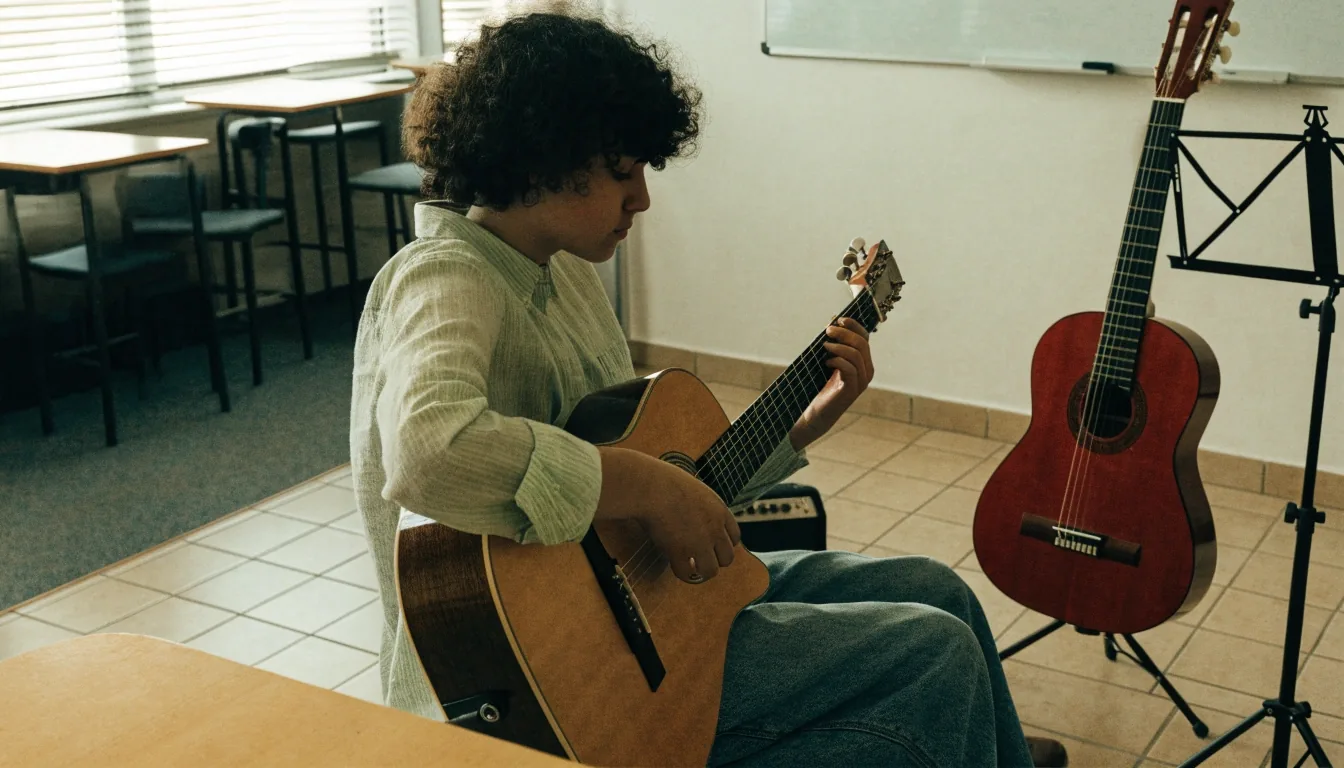
Most beginners who come to us own an acoustic, often because it's the instrument people buy when they decide to learn. That's a reasonable place to start. Acoustic guitar is unforgiving about fretting pressure, which means your hand strength develops quickly and the habits you build transfer to electric later.
What the first weeks look like
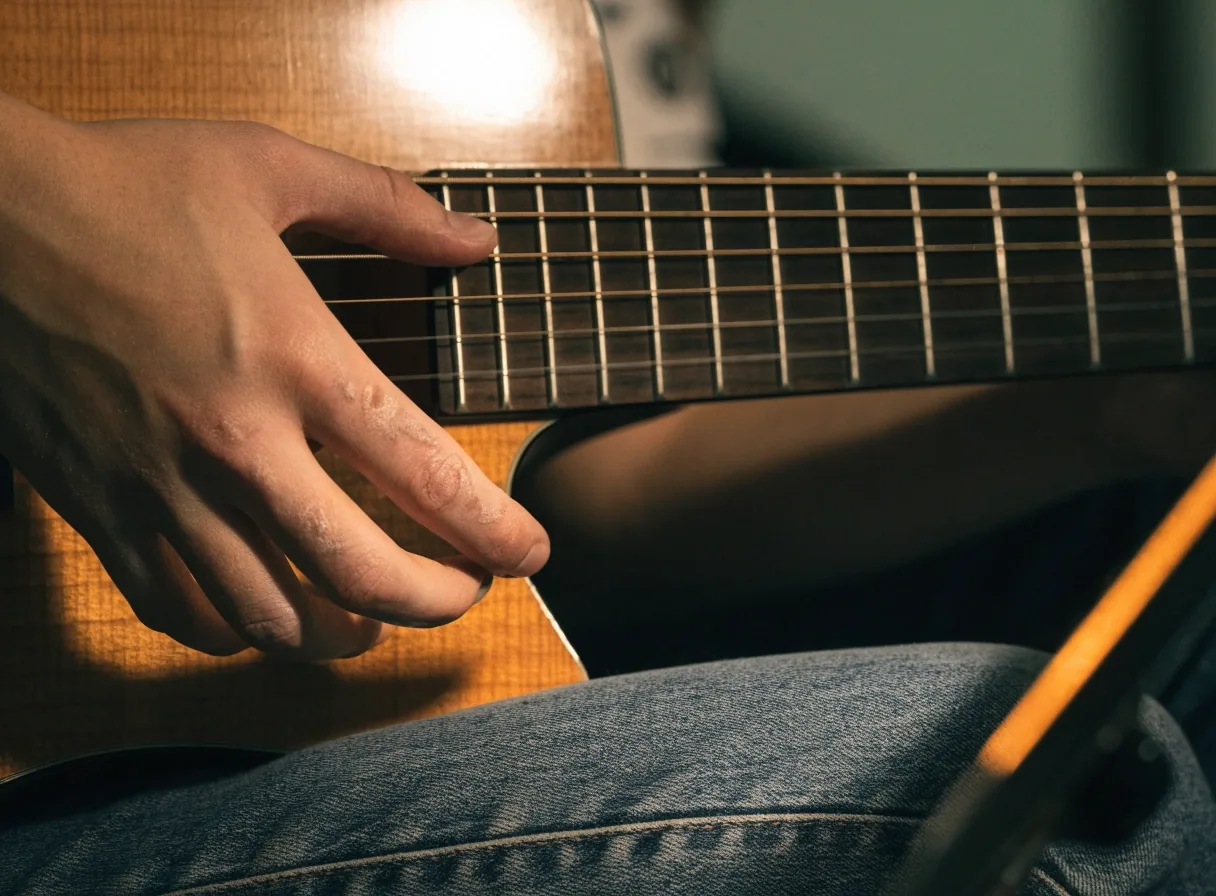
Early acoustic lessons focus on open chords, strumming patterns and enough rhythm to play along with a recording. Singing and playing at the same time comes next for many learners, and it's a coordination skill rather than a talent — it responds to slow, repeated practice like anything else.
Chord changes stay slow for longer than people expect. That's normal rather than a sign you're doing something wrong, and we'll show you exactly which change is costing you the most time so practice goes where it counts.
Electric guitar and what changes
Electric guitar is easier on the fingers and harder on the ears. The lighter strings and lower action mean you can play longer before your hand tires, but every unintended noise is amplified.
Lessons usually lean towards riffs, power chords, tone and improvisation. We cover amplifier settings early, because a learner fighting a badly set amp will sound worse than their playing deserves. Pedals come in once you know what you're listening for — before that they add options you can't yet judge.
Riffs and power chords
The backbone of most electric playing you'll want to learn first.
Tone and amp settings
Set up early so practice sounds like the record you're aiming for.
Improvisation
Blues and rock soloing, built on shapes you already know.

Classical guitar and reading
Classical guitar is the most structured of the three. It uses a nylon-string instrument, a footstool and a seated posture designed for both hands to work independently. Most classical players read notation rather than tabs from an early stage.
If you've never read music, that isn't a problem, but it does mean the first few months move at a different pace to a chord-based acoustic course.
The technique pays off in finger independence, and plenty of electric players study classical for exactly that reason — the right hand alone is a serious workout.
Common classical questions
- Do I need to read music?
- Not to start. Classical works from notation, and we'll teach you to read it from the beginning if that's the route you're taking.
- Is it suitable for adult beginners?
- It's one of the better routes. Technique is taught from scratch, so there's no assumption of prior experience, and the repertoire is written to be played solo.
- Do I need a different instrument?
- Classical uses a nylon-string guitar, so you'll need one rather than a steel-string acoustic. Ask in your enquiry if you're unsure what to look for.
Grades give you a defined target and feedback from outside the room. If the syllabus is draining the enjoyment out of playing, say so — we'd rather change the plan than lose the player.
Beginner guitar lessons in practice
A beginner's first month covers a small set of open chords, a strumming or picking pattern, and one song you can actually play end to end. We introduce theory alongside it, so the notes on the page connect to something your hands already know.
Chords and changes
A small set of open chords, then the changes between them. We work on the ones slowing you down rather than adding more shapes.
Rhythm and strumming
A pattern you can keep steady, because playing along with a recording is where rhythm gets tested.
One song, played through
Something you can play end to end from the first month, so practice has a finish line you can hear.
Theory that attaches
Names for chords, keys and intervals as they come up, so the page connects to something your hands know.
Most beginners can play a simple song recognisably within a few weeks of regular practice. What matters most in that stretch is short, frequent sessions rather than one long one at the weekend.
Intermediate players and plateaus
Intermediate learners usually arrive with a specific problem: barre chords that don't ring, solos that fall apart at speed, or a repertoire of half-learned songs. These are fixable, but they need diagnosis rather than more material.
We spend the first session or two working out what's actually holding you back. Often it's tension, an inefficient picking hand, or never having learned to play in time with anything. Once identified, the fix is usually smaller than expected.
How a diagnosis session works
Tension
Gripping harder than the string needs limits speed more than weak fingers do.
Picking hand
An inefficient picking motion costs accuracy long before it costs speed.
Playing in time
Without a steady pulse, everything written on top of it stays fragile.
Exam preparation and graded syllabuses
Exam preparation follows the recognised UK board syllabuses, covering set pieces, scales and arpeggios, sight-reading and aural tests. We work through the requirements in order and introduce mock conditions closer to the exam date.
What's covered
Set pieces and technical work
Set pieces, scales and arpeggios worked through in the order the syllabus lists them.
What's covered
Sight-reading and aural
The two areas learners most often leave late. Both get regular short practice rather than a last-minute push.
What's covered
Mock conditions
Run closer to the exam date so the room, the order and the waiting feel familiar.

Styles we teach
Across the three instruments we cover the styles most learners ask for. If you're chasing a very particular sound or technique, say so in your enquiry — it's better to find out early than after three lessons.
-
Pop and rock
On acoustic and electric, chord-driven songs and the riffs that go with them.
-
Blues
Shuffles, bends and phrasing, with room to improvise over a simple progression.
-
Folk fingerstyle
Thumb-and-fingers patterns where the picking hand carries the arrangement.
-
Classical repertoire
Solo pieces read from notation, from first studies up to exam-level works.
-
Jazz
Welcome, with the caveat that we'll be upfront about how much of the ground we can cover well.
-
Metal
Also welcome. Rhythm accuracy and picking control matter here far more than raw speed.
Matching level and pace
Lessons move at your pace, not a syllabus pace. Some learners want to be pushed hard and corrected constantly. Others need a gentler approach, particularly adults returning to an instrument after decades away.
Both are fine. What matters is that you tell us which you'd prefer, because a tutor guessing wrong on this is the most common reason lessons stop being useful.
Choosing what to work on first
If you're not sure where to begin, the answer is usually one song you want to play. It gives the technique work a purpose, and it makes practice something you look forward to rather than a chore.
We'll build the supporting work around it. Scales, chord drills and reading all fit into the gaps once there's a piece of music you're genuinely motivated to finish.
What to look for in a tutorQuestions before you enquire
Do I need to read music to take lessons?
No. Most acoustic and electric learners work from chord charts and tab. Classical guitar uses notation, and we'll teach you to read it from the start if that's the route you're taking.
Can I learn more than one style or instrument at once?
Yes, within reason. Splitting a single lesson between two instruments slows progress on both, but alternating weeks or focusing one per term works well for many learners.
Is classical guitar suitable for adult beginners?
It's one of the better routes for adults, actually. The technique is taught from scratch, so there's no assumption of prior experience, and the repertoire is written to be played solo.
I played years ago and have forgotten most of it. Where do I start?
Mention your previous experience in the enquiry. We'll spend the first session testing what's still there and build from that point rather than starting over.
Tell us your instrument, style and level
Send a lesson enquiry with what you play, what you'd like to work on, and any exam or repertoire targets. We'll come back with how we'd shape the lessons and where to start, then you can decide whether it's the right fit. No prices are published on this site — everything is discussed directly once we've talked through what you need.
Where to find us
Fretwork Guitar Tuition12 Elm Grove
Brighton BN2 3ES
United Kingdom
- Phone
- +44 1273 659091
- [email protected]
- Hours
- Monday to Friday, 9:00 AM – 6:00 PM
Saturday, 10:00 AM – 4:00 PM