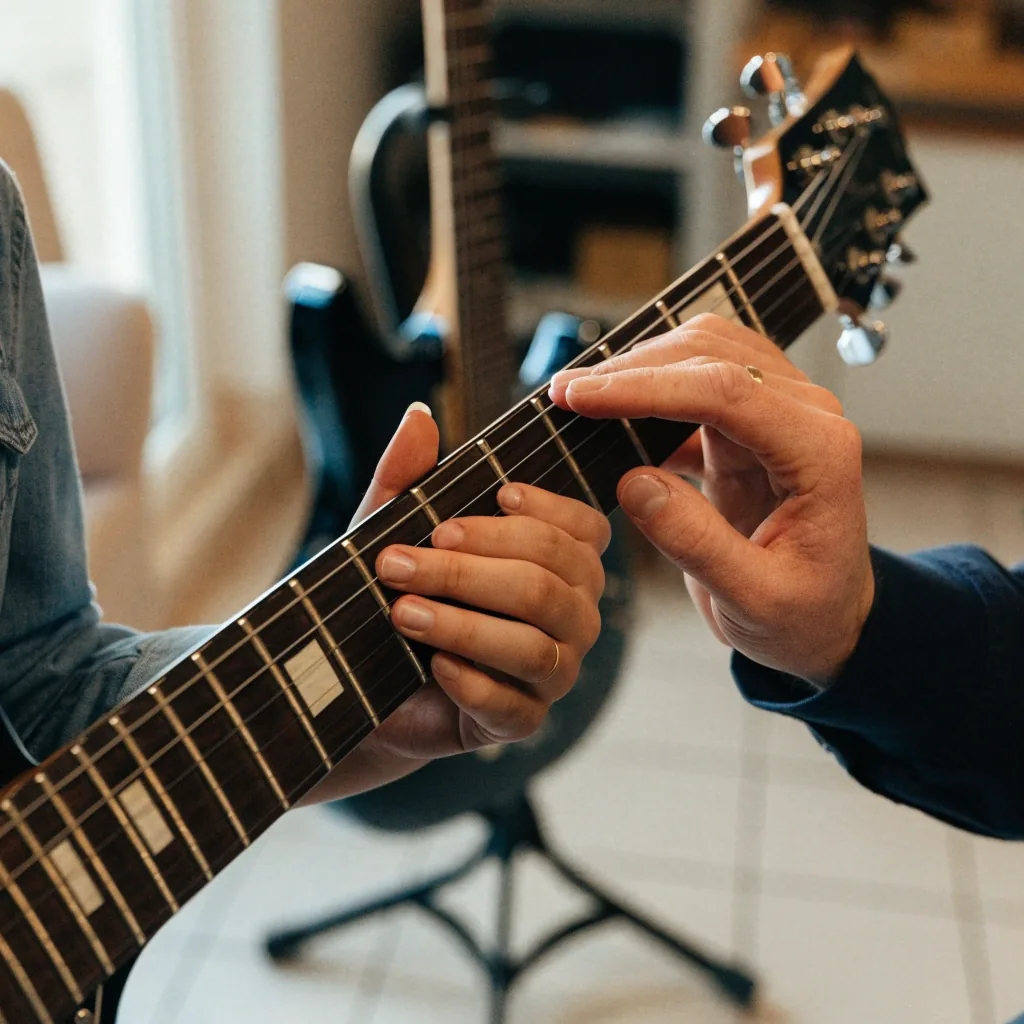
A tutor adjusting a student's fretting hand during a guitar lesson in a bright teaching room
Answers before your first lesson

Common questions about guitar lessons

These are the questions that come up most often in lesson enquiries: whether online lessons work, what you need before starting, how much practice is realistic, and what happens after you get in touch. Short answers below, with more detail on the lessons and teaching pages.

The short answers

Below are the six questions we answer most often, grouped by what you're deciding: whether you can start from nothing, which instrument to get, how lessons run, and what the enquiry actually leads to. Scan the headings, open the ones that apply, and skip the rest.

If your question isn't here, send it through the enquiry form and we'll answer it directly rather than leave you guessing between the paragraphs.

  • Starting out with no musical background
  • Lesson formats and equipment setup
  • Practice, exams and scheduling
I've never played anything before. Is that a problem?

No. Complete beginners are the largest group we teach, and no prior musical experience is needed. The first lesson starts from how to hold the instrument, where your thumb sits on the neck, and how to press a single string cleanly before anything else is added.

Which guitar should I buy as a beginner?

Ask us before you buy. Mention your budget in the enquiry and we'll suggest realistic options. A well-set-up used instrument is usually a better start than a cheap new one, and we'd rather point you toward something with a straight neck than have you spend on a guitar that fights you for the first six months.

How quickly will I be able to play a song?

Most beginners can play something recognisable within a few weeks of regular practice. Chord changes take longer to feel smooth, and that's normal rather than a sign of slow progress. Learners who practise in short daily bursts usually get there sooner than those who save it all for one weekend session.

Do you teach online only, or in person as well?

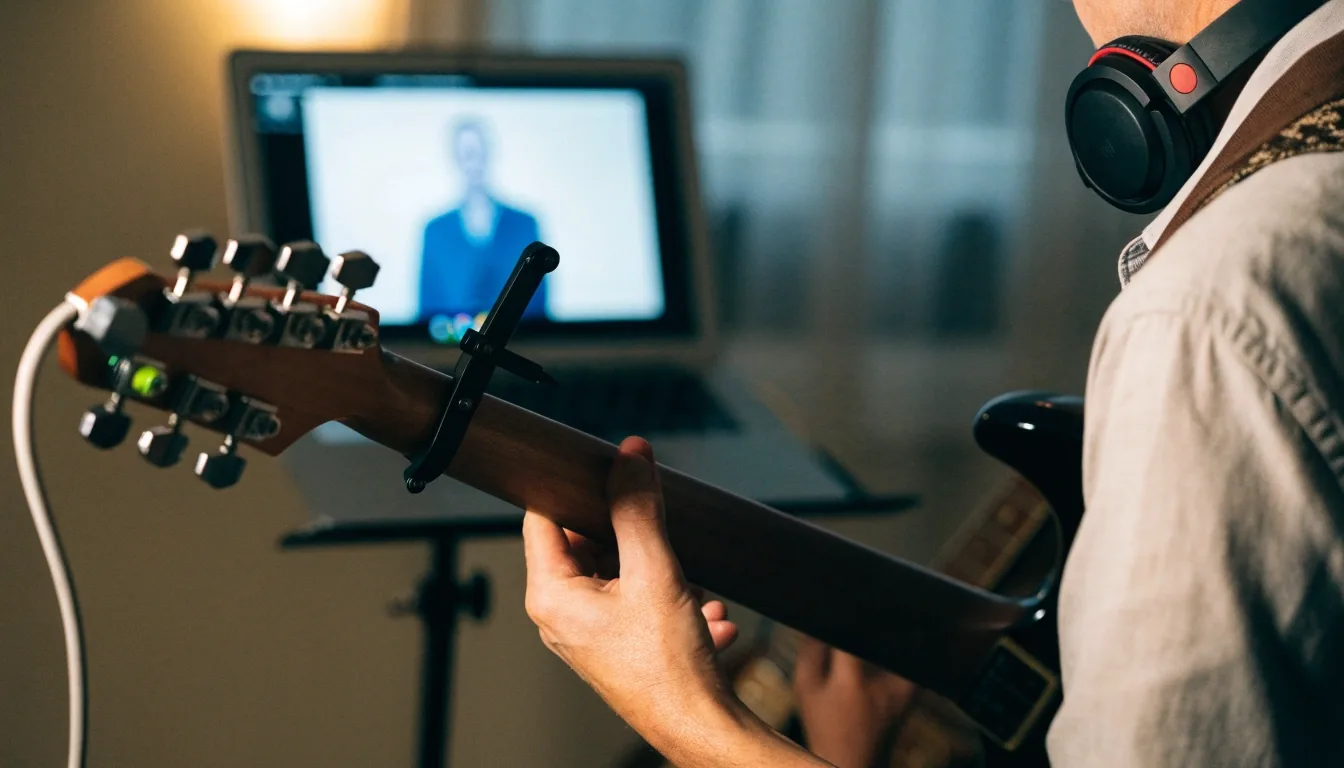
Both. Face-to-face lessons run in the studio and live online guitar lessons run over video call, with the same tutor and the same one-to-one format. Nothing is pre-recorded, so you can stop the lesson and ask about the bar that isn't working.

Can I try a single lesson before committing?

Yes. Say on the enquiry form that you'd like to start with an initial session, and we'll arrange a single lesson with no obligation to book further. Plenty of learners use it to find out whether weekly lessons suit their week before they set anything in the diary.

What happens after I send the enquiry form?

We read it and reply with a suggested format and the next available slot. From there you can ask questions, adjust the plan, or decide it isn't the right fit. No account to create, and no payment details are needed at the enquiry stage.

Starting out

You don't need any musical background to begin. Beginner guitar lessons start with posture, a clean single note and two chords you can move between. Most learners can play a simple song recognisably within a few weeks of regular practice, though chord changes stay slow for longer than people expect — that lag is part of learning, not a warning sign.

You do need a playable guitar. If you haven't bought one, ask before you spend; we'd rather point you toward a sensible used instrument than have you buy something with a warped neck that never sits in tune. Tell us your budget and whether you want acoustic or electric, and we'll narrow it down from there.

Age isn't the barrier people assume either. We teach teenagers and adults, and the early lessons look similar for both. What changes is the music you bring in and how much time you can put between sessions.

What you need on day one

  • A guitar that holds its tuning and has a straight neck
  • A clip-on tuner — inexpensive and steadier than tuning by ear at the start
  • Nothing else. No amplifier, no pedal, no theory book to buy first
Hands on an electric guitar during a live online guitar lesson, with headphones and a headstock tuner nearby

Lesson formats

Face-to-face lessons put the tutor in the room, which helps most with hand position and technique in the early months. Live online guitar lessons run over video call in real time, with the same one-to-one structure and no pre-recorded material.

In the studio

Face-to-face lessons

Best for the first months and for anything physical: fretting pressure, picking angle, the way your wrist moves through a chord change. The tutor can see the problem and correct it in the moment, without asking you to angle the camera at your hand.

If you plan to sing along, a capo is worth having within the first month or two, and we'll cover how to move it without losing your place.

Over video call

Live online lessons

Online works well for repertoire, theory, rhythm and most technique work. It's weaker on fine physical detail, so we lean on clear descriptions and short recorded demonstrations you can replay between sessions.

Some learners switch between the two when their circumstances change, and the lesson material carries over — you pick up where the last session stopped rather than starting the syllabus again.

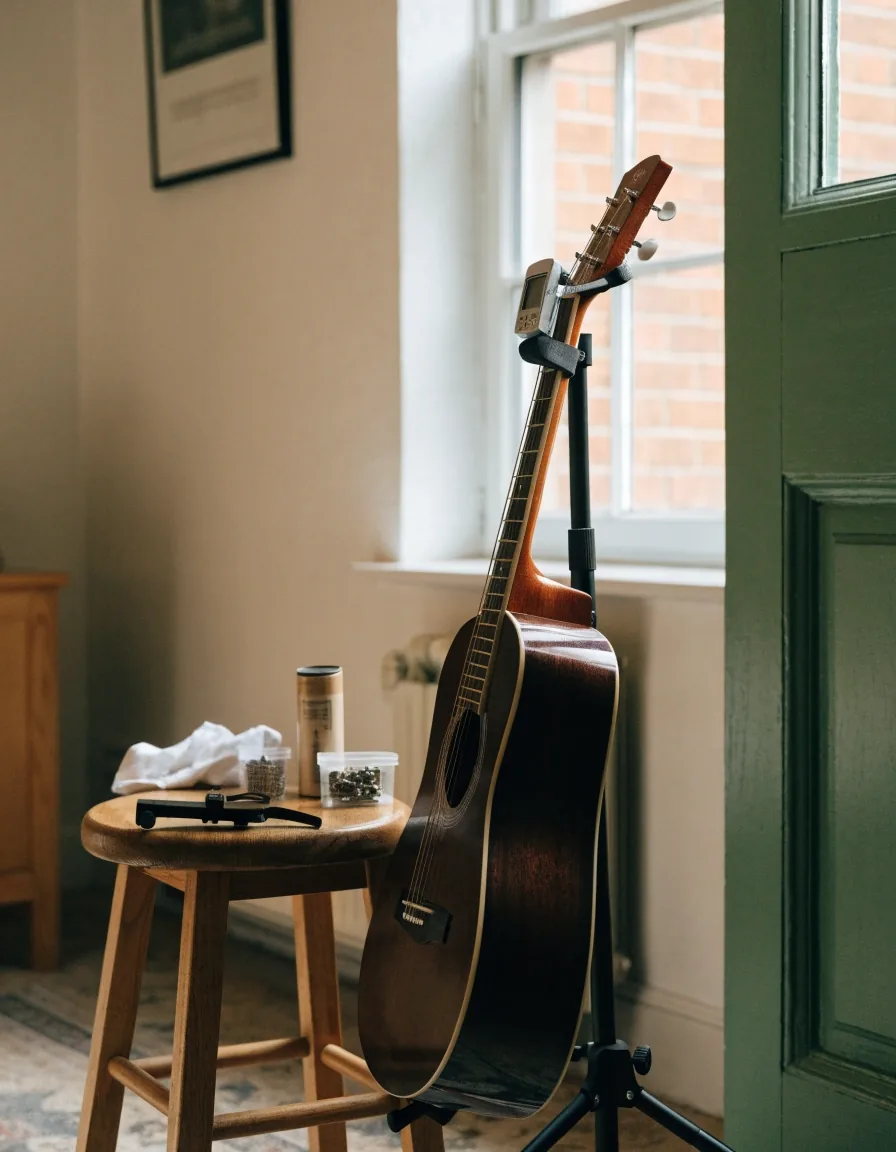
Clip-on tuner, capo and spare strings laid out beside an acoustic guitar in a teaching studio

Equipment and setup

The minimum is a guitar and a tuner. Clip-on tuners are inexpensive and more reliable than tuning by ear when you're starting, because you can check yourself before every practice session without needing a reference note.

For online lessons, a laptop or tablet on a stand works better than a phone held in one hand. Headphones help in a shared space, and a simple audio interface improves sound quality if your guitar has a pickup — though it isn't needed to start, and we won't send you shopping for one in week one.

A tuner
Clip-on, kept in the case. Worth more to a beginner than any pedal.
A capo
Useful within the first month or two if you plan to sing, so songs fit your voice.
A stand or stool
For online lessons, somewhere steady to rest a laptop or tablet so both hands stay free.
A quiet corner
Fifteen minutes without interruptions does more than an hour of half-attention.

Practice expectations

Frequency beats duration. Ten to fifteen minutes most days will move you further than one long session at the weekend, because your hands consolidate movement through repetition — and short sessions are easier to repeat on the days you don't feel like it.

Short and often

Ten to fifteen minutes on most days. Two-thirds of progress comes from the frequency, not the length of any one session.

A clear target

We set specific weekly targets rather than asking you to practise for a set time. Something like twenty clean chord changes at a steady tempo gives you a point to stop at.

Slow is a stage

Slow chord changes are expected for months. Speed arrives from accuracy, so we practise them slowly until the movement stops needing thought.

Exam preparation

We prepare learners for graded guitar exams through the recognised UK board syllabuses, covering set pieces, scales, sight-reading and aural tests. Mock conditions are introduced closer to the exam date so the format isn't a surprise on the day.

Grades suit some learners and not others. If the syllabus format takes the enjoyment out of playing, we'll suggest a different structure, such as preparing a fixed set of songs to performance standard. Either route gets you playing; only one of them is graded.

What graded preparation covers

  • Set pieces from the current syllabus list
  • Scales, arpeggios and technical work at the required tempo
  • Sight-reading and aural tests, practised under time
  • Mock runs at exam pace in the weeks before the date

Deciding on a grade is a conversation, not a default. Tell us what you want from the exam and we'll say honestly whether it fits.

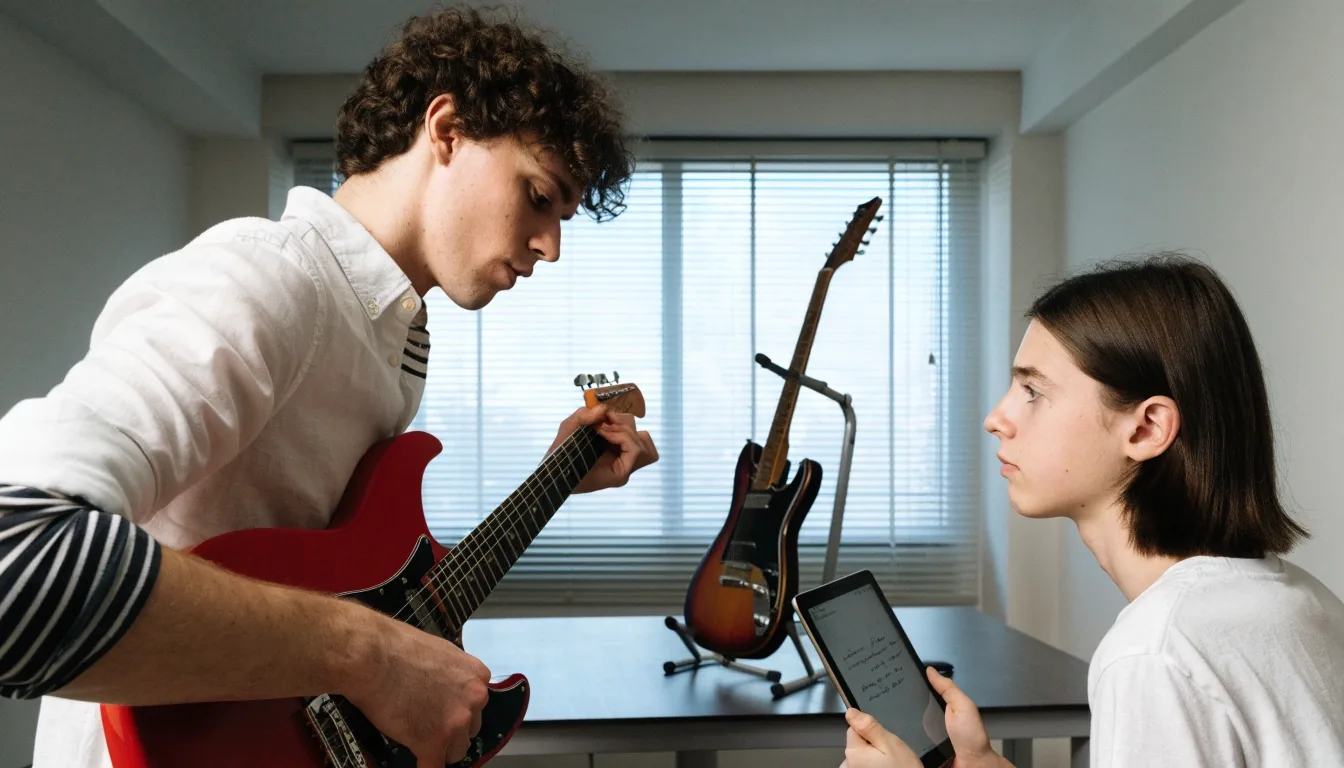
A tutor and student going through a practice plan at a table in a teaching studio

Enquiries, scheduling and next steps

We don't publish lesson prices on the site. You send a lesson enquiry with what you want to play, your level, your preferred format and your availability, and we reply with a recommendation and the practical details.

There's no account to create and no payment details required to enquire. An initial session is available if you'd rather test the format before committing to a regular slot.

Enquiries sent during working hours usually get a same-day reply; anything that arrives in the evening or at the weekend is answered on the next working day. Our hours are Monday to Friday, 9:00 AM – 6:00 PM, and Saturday, 10:00 AM – 4:00 PM.

Prefer to ask directly? Email [email protected] or call +441273659091. Lessons run from 12 Elm Grove, Brighton BN2 3ES.