
Lesson formats
Face-to-face and live online guitar lessons
Three ways to start at Fretwork, all one-to-one, none of them a group class or a fixed curriculum you have to follow. Below: what each format is good for, who tends to choose it, and what you would need ready before the first session.
Which of the three formats should you start with?
Read across the row that matches your week. Most people pick a format in a minute or two once this part is on paper, and the decision is not permanent — learners move between them when work or travel changes.
Lesson prices are not listed on this site. Send an enquiry with your goals and availability and we reply with the details for the format you are considering.
Format
Best for
What it asks of you
Face-to-face in the studio
Early months of learning, posture and fretting-hand detail, learners who want a weekly routine anchored outside the house.
A short regular journey, a predictable weekday slot, guitar in tune on arrival.
Live online over video
Repertoire, theory, rhythm and improvisation, irregular working hours, long commutes, limited teaching nearby.
A camera angle on your hands, a stand for the laptop or tablet, headphones in a shared room.
Initial trial session
Anyone who wants to hear how a tutor explains things before committing to a regular slot, either format.
Nothing beyond that one session. No obligation to book further.
Face-to-face lessons in the studio
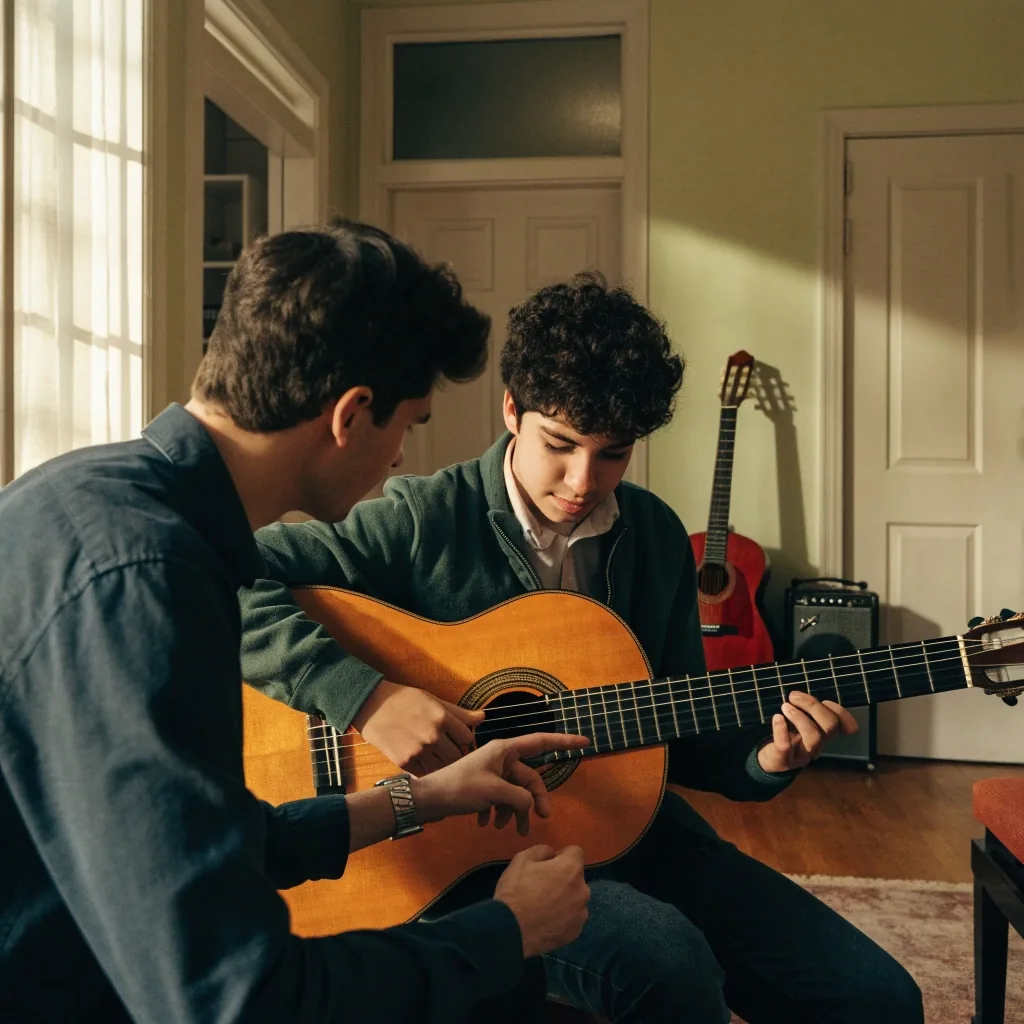
In-person lessons put the tutor in the room with your instrument. That matters most in the first few months, when small physical details decide whether a chord rings cleanly or buzzes. A tutor can see your wrist angle, your fretting pressure and your picking hand in a way that is genuinely difficult to assess through a screen.
- Session length
- 30 or 60 minutes
- Group size
- One-to-one, always
- Bring
- Your guitar and a notebook
- On site
- Spare instrument and amp if something needs checking
Live online lessons over video
Live online guitar lessons run in real time over video call, with the same tutor and the same one-to-one structure. Nothing is pre-recorded. You play, the tutor listens and responds, and the lesson adapts as it goes.
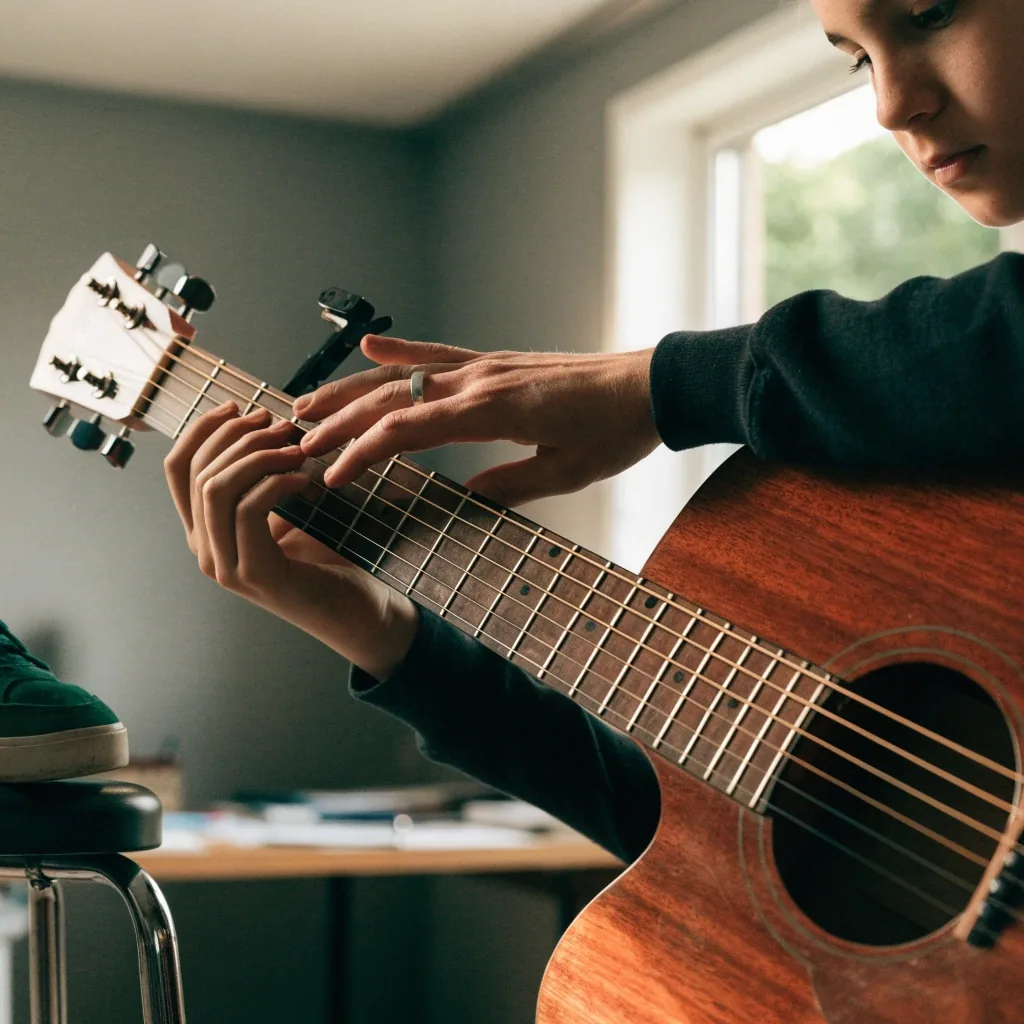
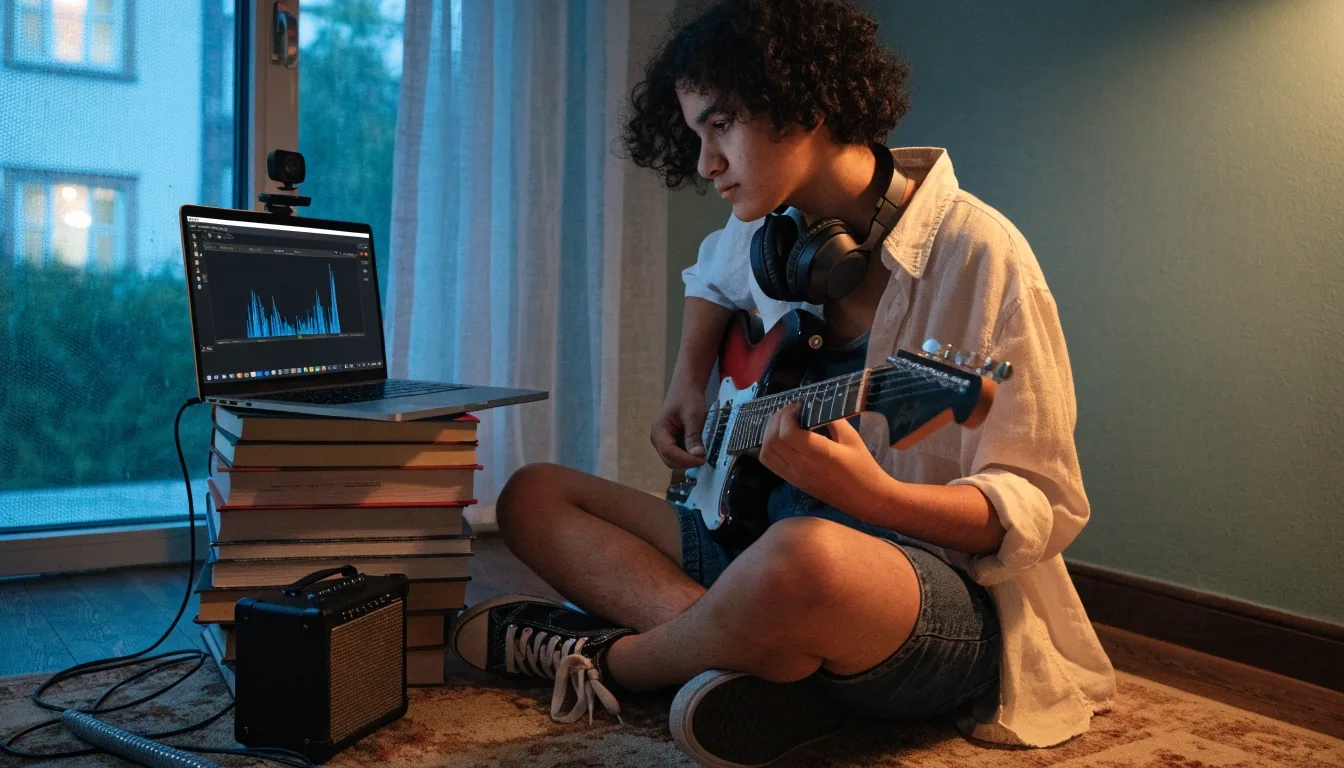
Before your first online session, it is worth testing your camera angle. Pointing a phone or laptop at your hands gives the tutor far more to work with than a head-and-shoulders view. Most learners set up once and then use the same position every week.
Set up before you join
- Angle the camera down at your fretboard and strumming hand, not your face.
- Put the device on a stand. A phone held in one hand ends the lesson early.
- Headphones help if you share the room with anyone else.
What works well over video, and what does not
This is the honest version, because the answer changes the format you should pick.
Strong over video
- Repertoire and learning a full song
- Scales, theory and fretboard knowledge
- Rhythm, timing and playing to a click
- Improvisation and soloing ideas
- Most technique work and exam preparation
Weaker over video
- Fine physical detail, such as a slight rotation of the fretting hand that fixes a buzz in the room
- Corrections that need the tutor to see pressure rather than angle
- Anything where two attempts over video become one second in person
That is a small delay, not a barrier, but it is worth knowing before you choose.
The initial trial session
An initial session is a single lesson with no obligation to book further. It exists because choosing a tutor from a webpage is difficult, and the fit matters more than most learners expect.
Use it to ask questions, try a technique you have been stuck on, or simply see how the tutor explains things. If it is not right, you will know quickly, and there is no awkwardness in saying so.
Before you book a regular slot
- Bring the thing you are stuck on, not a clean slate.
- Ask how practice between lessons is set and reviewed.
- Check the slot you want before you commit to a weekly routine.
Which format suits which learner
If your week is predictable and you have a short journey to the studio, face-to-face is usually the better default. Physical correction is faster, and the routine of leaving the house to play tends to protect the lesson slot when other things compete for the evening.
Online suits learners with irregular hours, long commutes, or limited local teaching options. It also works well for anyone who would rather not spend the travel time, particularly if the lesson is 30 minutes.
There is no penalty for starting online and moving into the studio a few months later, or the other way round. What you learn carries across both.
The instrument changes the answer
Classical guitar
Posture, footstool position and rest-stroke technique all benefit from in-person correction early on.
Electric guitar
More forgiving over video, since amplifier settings and pedals can be shown on camera.
Acoustic guitar
Comfortable in either format. For strumming and singing, a clear angle on both hands is usually enough.
Scheduling and how often to come
We keep a limited number of slots so that scheduling stays stable week to week. Mention your availability in the lesson enquiry and we will tell you what is currently open rather than guessing.
Check availabilityWeekly
The usual pattern. It keeps momentum and gives you a clear practice deadline before the next session.
Fortnightly
Works when work or study is heavy. Progress is slower and practice discipline between lessons matters more.
Changing a slot later
Tell us as early as you can. A change may mean moving to a different day or time, and we will work through the options with you.
Switching format
Give about a week's notice. Your lesson material carries across, so nothing restarts from zero.
Preparing for a lesson, in either format
Ten minutes of preparation buys you playing time. It is also the habit that makes practice between lessons actually happen.
-
1
Tune before you start
Tuning at the beginning of a lesson eats into playing time, and it is a habit worth building anyway.
-
2
Bring something to write on
A notebook, or your phone, to jot down what to practise before the week swallows the detail.
-
3
Online: join two minutes early
Sort out sound and camera before the start time so the full session goes on the guitar.
-
4
In the studio: come ready to play
Arrive with your guitar out of the case, tuned and in your hands.
Equipment for online lessons
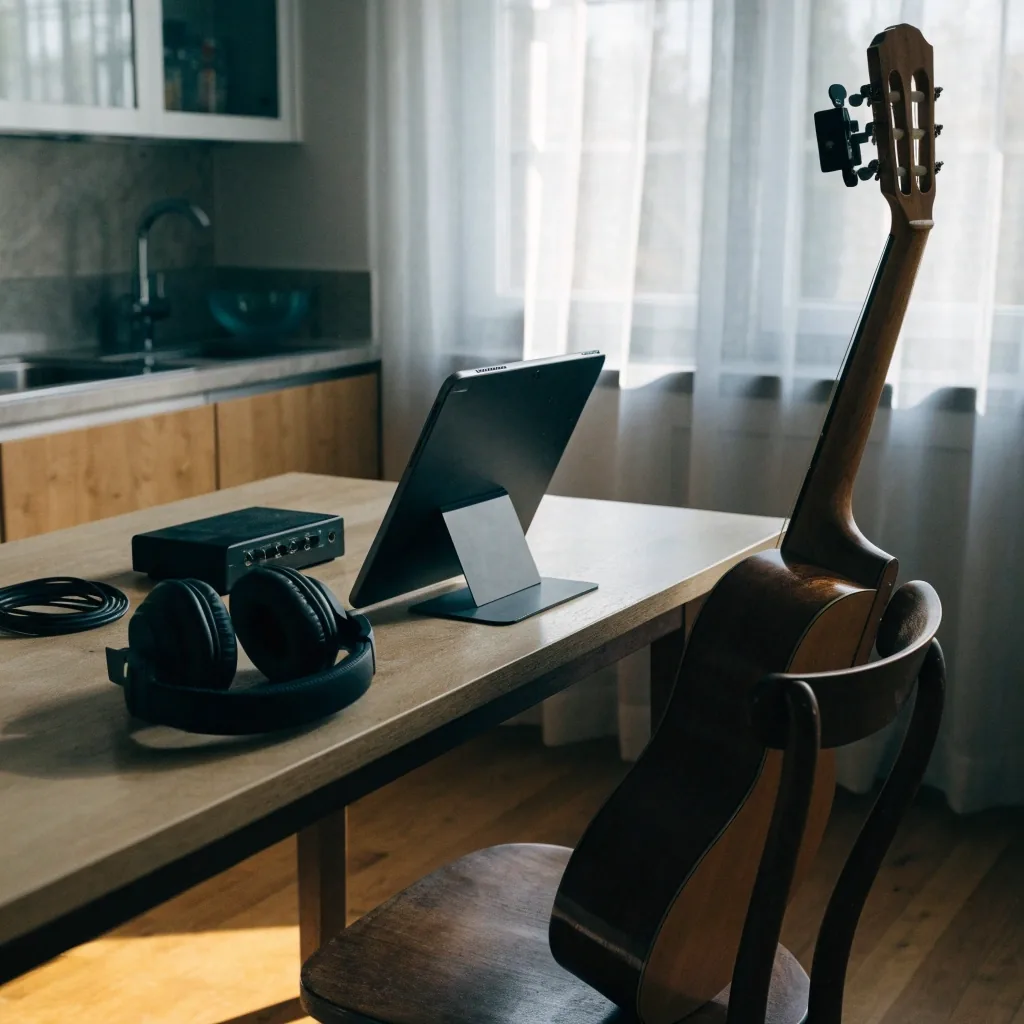
You need a guitar, a tuner, and a device with a camera and microphone. A laptop or tablet on a stand works better than a phone held in one hand. Headphones help if you are in a shared space.
If your guitar has a pickup, a simple audio interface will improve the sound quality a lot. It is not required to start, and we will tell you if it is worth buying for what you are working on.
Common questions about formats
If your question is not here, ask it in the enquiry and we will answer it directly.
Do online and in-person lessons cost the same?
We do not publish lesson prices on the website. Send a lesson enquiry with the format you are interested in and we will reply with the details for that option.
How many lessons should I book before I know if it is working?
Give it three or four sessions. The first lesson is about establishing where you are, and the format only starts to show its value once you have had a week of practice between each one.
What happens if I need to change my regular slot?
Tell us as early as you can. Regular slots are limited, so a change may mean moving to a different day or time. We will work through the options with you rather than leave you without a lesson.
Can I switch between online and in-person later?
Yes. Plenty of learners move between formats when their circumstances change, and the lesson material carries across. Just give us about a week's notice so the schedule can be adjusted.
How to decide, and what happens next
Pick the format that removes the most friction from your week, not the one that sounds most impressive. A learner who reliably turns up to online lessons every Tuesday will progress faster than one who books in-person sessions and cancels half of them.
Send a lesson enquiry with your preferred format, your experience level and when you are free. We will suggest the format we would recommend for your goals and confirm the next available slot. If one-to-one teaching is new to you, the Choosing a Tutor page and the How We Teach page set out what to look for and how lessons are structured.
Fretwork Guitar Tuition, 12 Elm Grove, Brighton BN2 3ES. Studio hours Monday to Friday 9:00 AM to 6:00 PM, Saturday 10:00 AM to 4:00 PM. Email [email protected] or call +441273659091 if you would rather ask a question before filling anything in.