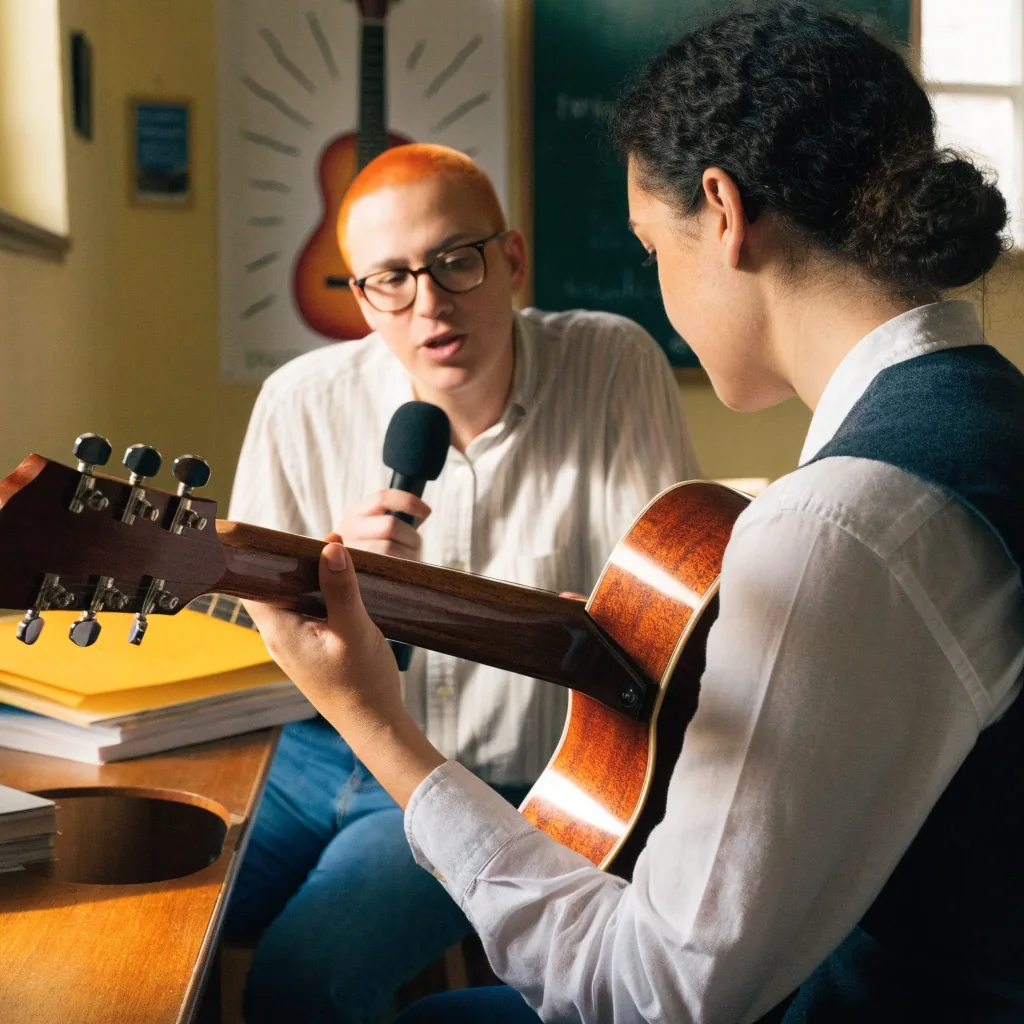
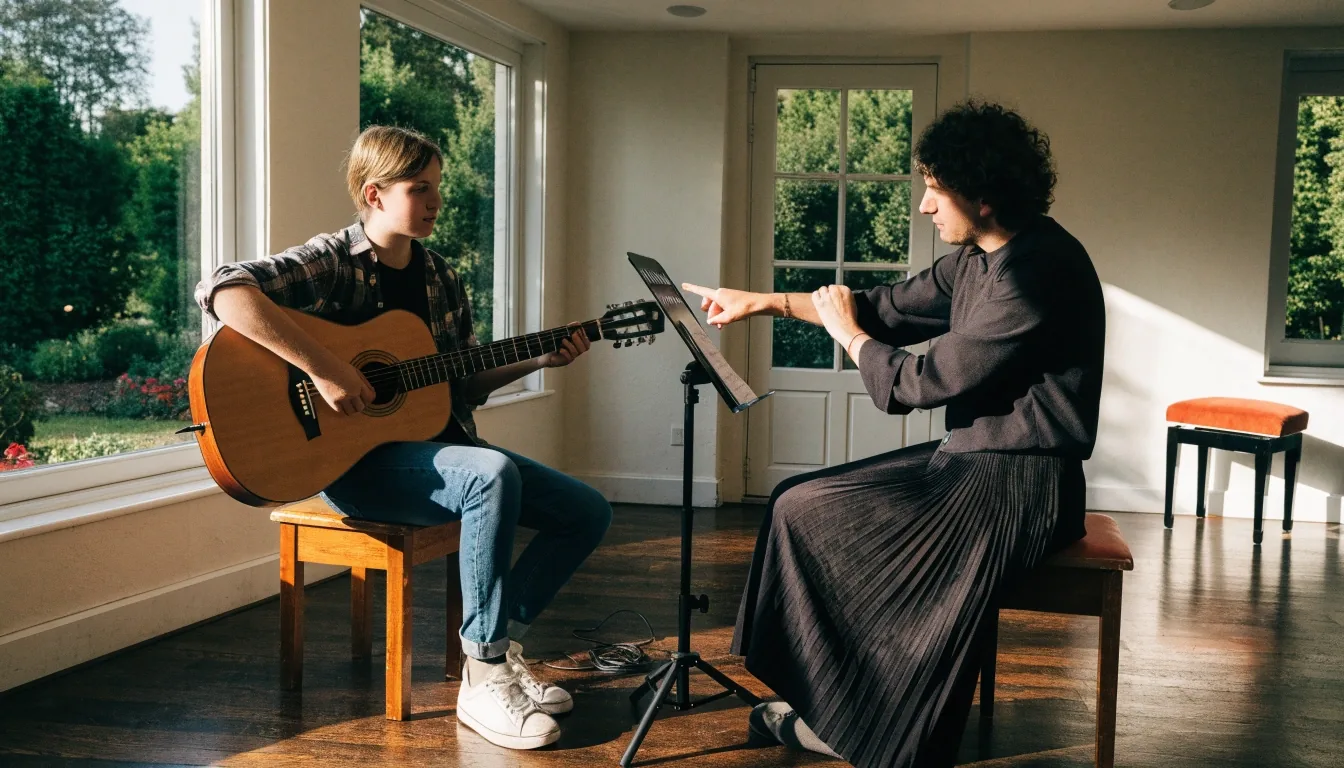
A learner practising an acoustic guitar with a tutor in a bright UK practice room

Choosing a tutor

How to choose a guitar tutor

The UK guitar tuition market is crowded, and the word "best" does not survive contact with it. What survives is a short set of practical questions about format, explanation, and terms — the ones this page walks through.

Why this page exists

A checklist beats a ranking

Tutor marketplaces list hundreds of teachers. Video libraries offer structured courses. Small regional music schools compete with national platforms. Sorting all of this by which website looks most polished is how people end up three lessons in and still unsure.

The approach below replaces that with comparisons you can actually run: same questions, same terms, same format, asked of every guitar tutor you contact before you commit to anything. It is written to be useful whether you end up enquiring with Fretwork or somewhere else entirely.

Start with the format you can actually keep, not the name you have heard most often.

Start with the format, not the name

Decide first whether you want in-person or online lessons. That single choice narrows the field faster than level, genre, or any tuition filter, and it is usually determined by your week rather than by the teacher.

If your schedule shifts constantly, or you live somewhere with limited local teaching, online is the practical choice. Sessions travel with you, and you are not negotiating a commute around a working day.

If you have a reliable hour each week and a short journey, in-person gives your tutor more to work with. They can hear the guitar unmediated, adjust your posture by hand, and pick up on tension that a compressed audio feed tends to smooth away.

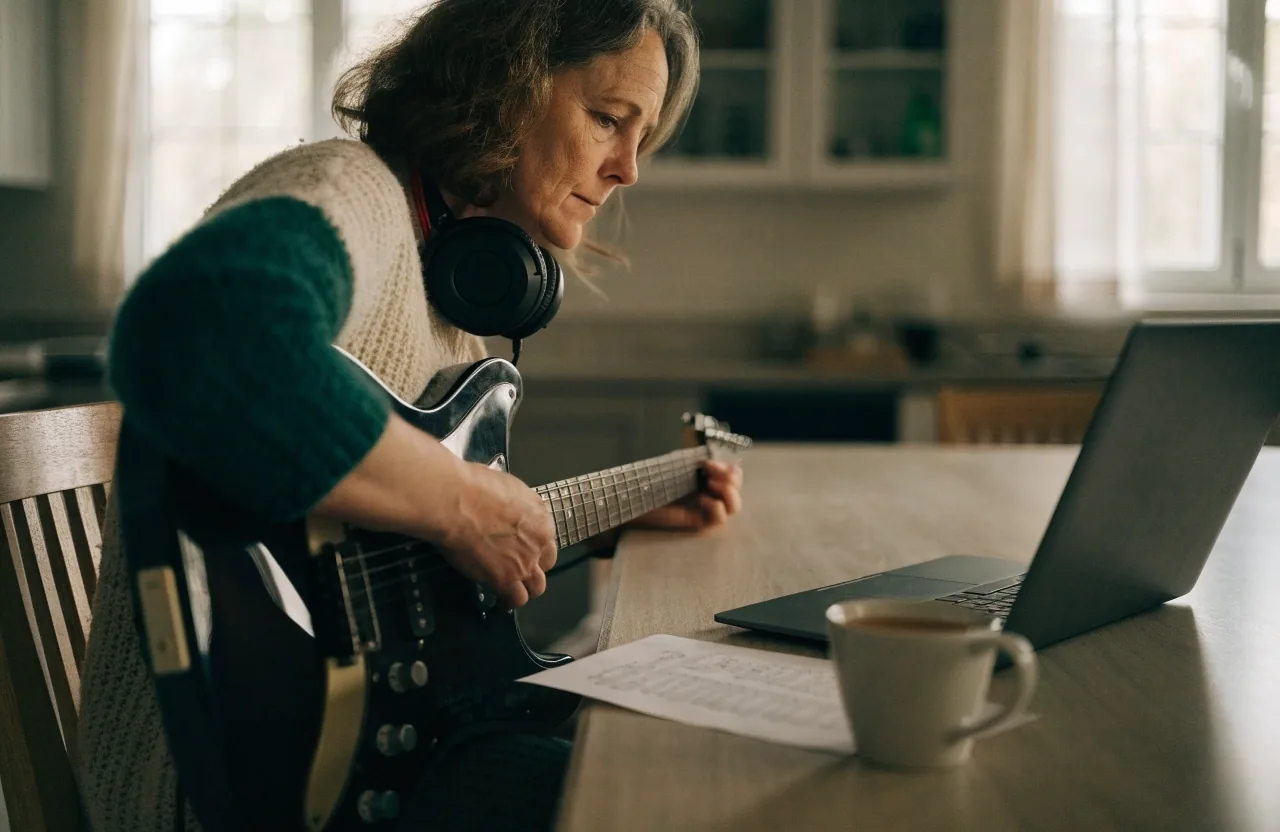
A learner playing guitar to an online lesson at a home kitchen table

Online lessons work best from a fixed spot in the house with a stable connection and a guitar you do not have to fight.

What to look for in a beginner teacher

For a complete beginner, the quality that moves you forward is clear explanation. These three signals separate teaching from showing off.

Break it down

Steps, not speed

A skilled player who cannot split a chord change into its parts will frustrate you, however good their own playing is. Someone less advanced who teaches methodically gets you further, faster, because every lesson ends with something you can practise on your own.

Practice gap

Ask what happens when you have not practised

The answer tells you a lot. A tutor who adjusts the plan, shortens the target for that week, or rebuilds the exercise around what you did manage is teaching you. One who simply repeats the same lesson is running out the clock.

First month

A plan you can hear described

Ask what they would teach you across your first month. Any honest tutor can describe the shape of it: what chords or songs you would touch, how practice would be set, and what they would be listening for when you play.

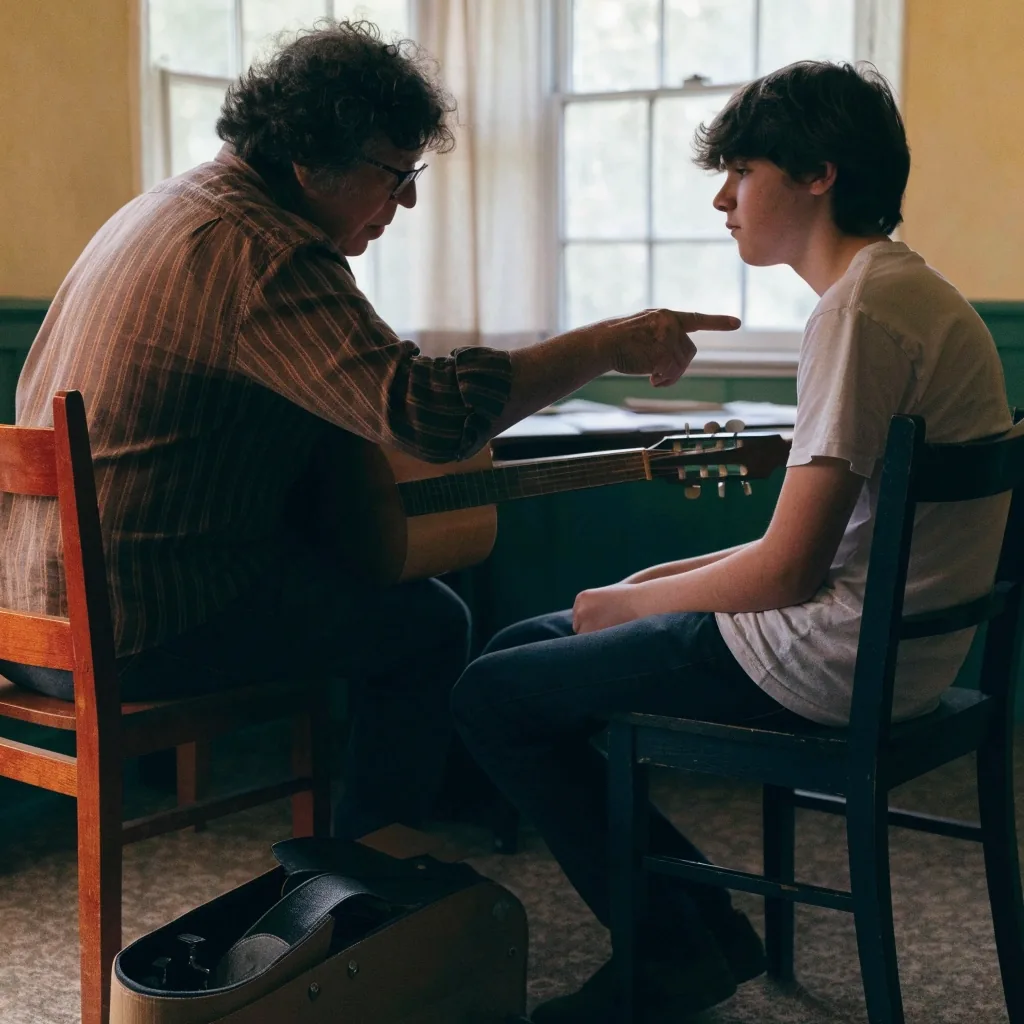
A tutor guiding a learner's fretting hand on a guitar neck

Judging a tutor profile honestly

Tutor profiles vary in what they prove. Years of playing, exam grades, performance credits, teaching qualifications — all of it is worth knowing, and none of it directly tells you whether this person can explain things to you.

Look for specifics over adjectives. A profile that names genres, levels and teaching formats tells you more than one that calls the tutor passionate and experienced. If the writing is vague about what actually happens in a lesson, assume the teaching may be vague too.

A small music teaching room with two chairs, a music stand and an open guitar case

How reviews fit into the decision

Review platforms carry a dedicated UK guitar instructor category, and listings show ratings and review counts for individual teaching businesses. That is a useful trust layer when you are comparing providers who do not publish prices.

Read them with some care. A long run of specific reviews describing a tutor's patience or clarity is more informative than a high score from a handful of ratings. Check whether the reviewer describes a situation close to yours — a returning adult with a busy job, a teenager preparing for a grade, a parent booking on a child's behalf.

Read them like this

  • Volume of detail beats a star average. One paragraph naming what a tutor changed is worth more than ten blank ratings.
  • Match the reviewer to your situation. A testimonial from a festival-level player says little about beginner repair work.
  • Check the dates. Reviews that stop two years ago tell you something about the business now.
  • Treat one glowing write-up and one angry one as background noise unless each is echoed elsewhere.

Marketplaces versus a dedicated teacher

Both routes work. Which one suits you depends on whether you value choice or continuity more, and how settled your week is likely to stay over the next six months.

Marketplace

Browsing at scale

Platforms like My Guitar Lessons let you browse tutors by location, schedule and style, then match through the platform itself. That is genuinely useful when you are moving cities, or want to see a broad spread of options before narrowing.

Trade-off: you are choosing from a catalogue, and the person you end up with may not be the one whose profile first caught your eye.

Dedicated teacher

Continuity over catalogue

A dedicated guitar tutor or small school works differently. You deal with the person who teaches you rather than a matching system, so the plan adjusts around your progress instead of resetting to a booking flow.

Trade-off: fewer names to compare, and you take on more of the judgement about whether the fit is right.

Where video libraries fit

Self-paced libraries like LickLibrary serve a different purpose. Structured video lessons let you work through material on your own timetable and revisit anything you missed — useful for building repertoire or drilling a solo you already understand.

They work best alongside live tuition rather than instead of it. A library cannot watch you play and tell you why your barre chord is muted, or that your thumb has drifted behind the neck. That feedback is what a lesson buys you, and it is the part you cannot pause and rewind.

Close view of a learner's hands practising a barre chord on an electric guitar

Regional schools and local identity

Small regional providers still matter in a digital-first market. A studio with a fixed local address offers something a purely online platform cannot: a place you can turn up to, with a door, a room, and a person waiting in it.

Whether that matters depends on you. Some learners find the physical location reassuring, especially on a first enquiry and on nerves before a grade exam. Others never need it, would rather not travel, and are happy for the whole relationship to live on a screen.

Where local tuition still reads clearly

  • Brighton
  • Aldershot
  • Stratford-upon-Avon
  • Kidderminster
  • Southampton

A fixed local address is not automatically better. It is a practical filter: either you can get there on a weekday evening, or you cannot.

Questions worth asking before you commit

Ask the same handful of questions of everyone you contact. Comparing answers to identical questions is far more useful than comparing how impressive each website looks, and it takes about ten minutes per enquiry.

What happens in a typical first lesson?

A clear answer describes what you would play, what they would listen for, and roughly how the hour is split between playing and explanation.

How is practice set and reviewed?

The good answer involves something written down or agreed, with a target you can measure yourself against between lessons.

What do you do when a learner plateaus?

Every long-term student hits a flat stretch. A tutor who has an answer for it has taught that stage before.

Can I switch formats or pause without losing my slot?

Life moves. Knowing in advance whether online weeks, holidays or a busy month are workable protects both sides of the arrangement.

If a tutor answers these vaguely, that is information too. Clear answers, even ones you disagree with, suggest someone who has thought about how they teach rather than someone improvising each week.

Red flags

Signals worth pausing on

Be cautious of anyone who promises a specific result in a fixed timeframe, or who cannot explain what they would teach you in the first month. Teaching is a process, and no honest tutor can describe your outcome before they have seen you play.

Also check the practical side: what is the cancellation policy, is there a minimum commitment, and how do you get in touch if something changes? Over a year of lessons, these details matter more than any marketing claim.

A simple method

A simple comparison method

  1. 1

    Write down what you actually need: format, approximate frequency, style, and any deadline such as an exam.

  2. 2

    Check each guitar tutor or provider against that list, rather than against each other.

  3. 3

    Ask the same two or three questions of everyone you contact and compare the answers side by side.

  4. 4

    Book an initial session with the one whose answers match your list most closely, then judge the teaching from inside the room.

Questions learners ask us most

These come up in nearly every enquiry, whether the answer ends with us or with a different teacher.

How do I know whether a tutor is credible before I enquire?

+

Look for specifics: named genres, levels taught, formats offered, and a clear description of how lessons are structured. Review listings on platforms with a UK guitar instructor category can add context, especially where a provider does not publish prices up front.

Is a marketplace better than booking directly with a tutor?

+

Marketplaces are useful when you are comparing many options at once or relocating. Booking directly usually gives you more continuity, since you deal with the person teaching you rather than a matching system between you and them.

Should I ask about qualifications?

+

It is reasonable to ask, and reasonable for a tutor to answer honestly. Exam grades and teaching diplomas are useful context, but how clearly someone explains things will affect your progress more than the letters after their name.

What if the first tutor isn't right?

+

Move on rather than persist out of politeness. An initial session exists so you can find out early, and most tutors would rather you switch than keep attending lessons that are not working for either of you.

A quiet guitar teaching room at dusk with an acoustic guitar on a stand

If you want to compare us against the list, we are happy to answer the same questions

Tell us whether you are leaning online or in-person, roughly how often you can practise, and what you would like to be playing in three months. We will reply with what a first block of lessons would look like, and you can take it from there.

Prefer to talk it through first? Call +44 1273 659091, email [email protected], or visit us at 12 Elm Grove, Brighton BN2 3ES. Weekday enquiries are answered between 9:00 AM and 6:00 PM, and on Saturdays between 10:00 AM and 4:00 PM.